

Leaderboard
-

AggiesAreWe
SETXsports Director/ManagerPoints96,187Posts -
prepballfan
SETXsports StaffPoints8,171Posts -
piratevillain
MembersPoints1,444Posts -



Popular Content
Showing content with the highest reputation on 11/23/2021 in all areas
-
PN-Gs Noah Jackson returns home!!!!!!
WOS1986 and 5 others reacted to prepballfan for a post in a topic
6 pointshttps://www.facebook.com/NDNPress/videos/49969163070197536 points -
HJ VS ATASCOCITA
87JAG and 2 others reacted to HawkPride4life for a post in a topic
3 pointsFINAL (VARSITY) HJ 79 ATASCOCITA 66 HJ LADY HAWKS TAKE DOWN 6A #8 STATE RANKED ATASCOCITA IN A HIGH PACED, ELITE LEVEL GAME. MAN THESE GIRLS CAN BALL! ON TO THE NEXT! RANK MY GIRLS IN TOP 10 FOR 6A EVEN THOUGH WE ARE ONLY 4A. HA WE WANT ALL THE SMOKEEEEEEEEEEEE!3 points -
Attend Regional playoffs?
DP#1FAN and 2 others reacted to AggiesAreWe for a post in a topic
3 pointsSame for me: Friday: North Shore vs. Katy Tompkins 1 pm then WOS vs. Bellville 6 pm. No Saturday football for me. Going to check out some local high school basketball that day. Huffman at Lumberton Kountze at WO-S United vs. West Brook3 points -
West Orange Stark Mustangs vs Bellville
Gasilla and one other reacted to football life for a post in a topic
2 pointsI didn't say that!! Bcz T/O are still apart of the game.and let's not forget abt penalties.w.o can't afford to give them short field positions.theyre too gud to give Bellville a short field.if w.o can't make them have long drives and continue to retaliation from dump stuff they're gonna get beat.these penalties are killers!! And w.o will be at home if they don't clean this up.it has been a problem.2 points -
PN-G 8-4 vs Texas High 11-0, Friday 6:00, Natchitoches LA
the weasel and one other reacted to Mr. Buddy Garrity for a post in a topic
2 pointsOh that's where they're hanging out at.2 points -
LCM vs EL Campo
Dat Brook and one other reacted to piratevillain for a post in a topic
2 pointshere's a full game highlights of El Campo's game last week condensed down. It's great channel to subscribe for TXHSFB games, and his videos are well done.2 points -
Bridge city is getting turf and a new track at the football stadium!!!
Mr. Buddy Garrity and one other reacted to piratevillain for a post in a topic
2 pointsInjuries are going to happen regardless, kids will just learn how to adapt playing on it. I know my nephew hated the grass field we had, he said there were so many potholes out there. But the pros and cons weighs out with it. Alot of people were up in arms about Vidor getting turf, but those same people are quiet as church mouse now because everyone benefits using it and not just Vidor.2 points -
PN-G 8-4 vs Texas High 11-0, Friday 6:00, Natchitoches LA
#COUGAR08 and one other reacted to png9mon for a post in a topic
2 pointsAnd don't forget that PN-G Fans greatly appreciate the Nederland team losing that game, just for us! LOL😆2 points -
LCM vs EL Campo
TrojanMoJo and one other reacted to LCM 83 for a post in a topic
2 pointsI've been on here for years. I use to post all the time when my daughter was playing. However, I haven't signed on since about 2012. Couldn't find my old sign-on or password. Had start all over. But been reading everyone's post since 2012.2 points -
Sideline to Sideline 4A and 3A 3rd Round Playoff Show
Dat Brook and one other reacted to Tiger33 for a post in a topic
2 points@Gsquaredi like yalls observation on LCM. Our defense will have to play the best all year to beat EC. Our DE #90 Amier Washington who has offers from Baylor and Texas Tech will have to be a leader on the Defense! First year Coach Peevy has turned LCM around from 1-8 last year and we are a 10-2 program.2 points -
West Orange Stark Mustangs vs Bellville
TrojanMoJo and one other reacted to GUNHO for a post in a topic
2 pointsI like playing the game on the field myself.Just saying.2 points -
PN-G 8-4 vs Texas High 11-0, Friday 6:00, Natchitoches LA
PNG Proud and one other reacted to the weasel for a post in a topic
2 pointsAgain picking the Indians. Their strength of schedule and being battle tested proved on point last week. Kids were never phased throughout a high scoring back and forth TD Game. With that being said, going with a 38-28 Indian Victory. Scalp Em!2 points -
PN-Gs Noah Jackson returns home!!!!!!
MrFleet23 and one other reacted to NDNation for a post in a topic
2 pointsHome in time for Thanksgiving!2 points -
Bridge city is getting turf and a new track at the football stadium!!!
piratevillain and one other reacted to Majestyk for a post in a topic
2 pointsI wonder what the injury numbers are for the people who play football vs the ones who don't.2 points -
West Orange Stark Mustangs vs Bellville
Gasilla and one other reacted to GUNHO for a post in a topic
2 pointsI said earlier in the season if we played Bellville then we would lose but if we met them in the 3rd round that would give us time to improve and get better.We have gotten better and I like our chances.They have a good defense but not as good as Jasper and I think we can score 3-4 td's and that might be enough.Key is to keep the mistakes to a minimum and not turn the ball over.2 points -
LCM vs EL Campo
piratevillain and one other reacted to Gasilla for a post in a topic
2 pointsThis the type of game LCM can win. Put as many as you can at or near the LOS and make them beat you with the pass.2 points -
PN-G 8-4 vs Texas High 11-0, Friday 6:00, Natchitoches LA
NDNWarrior and one other reacted to uptheWay for a post in a topic
2 pointslot of respect for teams that can keep it going for me lol I would rather ask how they do it than sit back and hate them for doing it2 points -
West Orange Stark Mustangs vs Bellville
Dirty_but_Dazzling and one other reacted to Gasilla for a post in a topic
2 pointsThe same team Jasper shut out.2 points -
West Orange Stark Mustangs vs Bellville
griff and one other reacted to Gasilla for a post in a topic
2 pointsI keep seeing folks talk about how "talented" this team is (as if it's not as talented as usual). The only area that is not where it would usually be is at the QB position. Other than that, the Mustangs are loaded. Early on we were hurting at the LB position, but those guys have come miles since the beginning of the season. They are playing like seasoned vets and it shows with 2 shut outs and 2 one score games in the last 4. In fact, the defense has 2 D1 commits with a 3rd any day with Shaw supposed to commit soon. The O-line is big and has a D1 commit to OU. We definitely are not "less" talented than normal. We just have a sore spot, but its getting better, too.2 points -
HJ VS ATASCOCITA
HawkPride4life reacted to TrojanMoJo for a post in a topic
1 pointCongrats 🎉🎊 Hardin Jefferson1 point -
Bridge city is getting turf and a new track at the football stadium!!!
piratevillain reacted to AggiesAreWe for a post in a topic
1 pointIt really was suppose to happen several years ago. When they built that stadium they built in the drain system for turf. Had a wealthy donor ready to write the check for the turf but she passed away and the executor of the will decided not to follow through on the donation. A feasibility study was done a few years ago by the school to see about purchasing the turf itself but some hiccups along the way with schools needing attention put it on the back burner. It will eventually happen. I say within 6 years.1 point -
1 point
-
BLM
Ty Cobb reacted to BS Wildcats for a post in a topic
1 pointThey need to be designated as a terror group. They are no better than pos Muslim terroists.1 point -
West Orange Stark Mustangs vs Bellville
Gasilla reacted to Morris_era for a post in a topic
1 pointAnd what’s crazy is they beat us with the pass not the run1 point -
LCM vs EL Campo
piratevillain reacted to Dat Brook for a post in a topic
1 pointHaha Don't take it personal... just people on the internet taking jabs. I would love to see a sea of Green, Gold, Black, Baby Blue, White and Red on the Visitor side cheering on the Bears. I just hope the defense shows up for LC-M or this could get ugly in a hurry.1 point -
West Orange Stark Mustangs vs Bellville
WOSdrummer99 reacted to wo-s#1 for a post in a topic
1 pointThat all sounds good 90% of the time…I seen WOS get whipped by a slot team 4years ago,so it can happen.Bellville is a really good team!1 point -
MS basketball tournament Jan 22nd
Who That reacted to AggiesAreWe for a post in a topic
1 pointJust sent you a message. Coach Sigler wants you to contact him.1 point -
The Grifting Never Stops, Does It?
baddog reacted to thetragichippy for a post in a topic
1 pointSend Kyle an AR for 2nd amendment rights or construct a statue of Floyd for police brutality......Depends on what you support I guess.1 point -
Very good information thanks.1 point
-
West Orange Stark Mustangs vs Bellville
football life reacted to Tiger33 for a post in a topic
1 pointCan we borrow Coach T for a group Coach meeting to show us some pointers how to defend EC lol1 point -
It’s amazing how you never get many comments on your post when facts and evidence is presented. Lol. Kinda like the mainstream media never covering facts and evidence. Truth has no agenda.1 point
-
PN-G 8-4 vs Texas High 11-0, Friday 6:00, Natchitoches LA
NDNation reacted to Mr. Buddy Garrity for a post in a topic
1 pointI have a Texan Live subscription so im good.1 point -
That is awesome. Happy for Noah and his family. Way to go PNG for putting kids first.1 point
-
Crosby vs A&M Cons
Cougar14.2 reacted to Matthew328 for a post in a topic
1 pointWatched much of last week's game on TexanLive, first time I sat and really watched Crosby since the opener vs Carthage and they looked like the real deal.....Definite favorites to get back to AT&T Stadium....I imagine with no restictons on crowd size this year there will be a ton of red in the stands if it happens1 point -
1 pointAnd Dershowitz is generally seen as a leftist. He is hardly they dyed in the wool conservative Republican. I don’t always agree with Dershowitz’s opinion however he backs it up with the law and does not seem to always draw sides based on his politics.1 point
-
Police kill 8 year old by shooting at a mistaken suspect vehicle
LumRaiderFan reacted to tvc184 for a post in a topic
1 pointI think they have a pretty wide latitude on use of force. In fact the public might be kind of shocked. Maybe the biggest case is Graham v. Connor. Graham was having a medical crisis for insulin shock. He ran into a convenience store to get some orange juice to get sugar into his blood but saw a line and immediately ran outside. He jumped in a car driven by a friend and he sped off to go to the next store. A police officer saw it and thought maybe he had witnessed an armed robbery because the guy ran in the store he came out a short time later in a hurry. The officer call for back up and stopped the vehicle with Graham. In his intoxication like the state from the hypoglycemia, he was kind of incoherent and the officers kicked the crap out of him. I think he had a broken ankle, some bruises about his head, and injured wrist, etc. Oops, it was not an armed robbery but a medical crisis. A completely innocent man who was having a medical crisis was thrashed by the police and sued and it went to United States Supreme Court. In a unanimous decision, the Supreme Court said, basically….. “Oh, well”. They came up with a term “objective reasonableness” saying that you had to put yourself in a position of an officer having to make a “split second” decision. They said it was easy with 20/20 hindsight to make a different decision however the police don’t have that luxury. In another case in front of the Supreme Court was Mullenix v. Luna that came out only six years ago this month. Texas DPS trooper Mullenix was involved in a high-speed chase. The driver of the car called Dispatch and he said he had a gun and he would shoot any police officer that tried to stop him and they needed to disengage in the chase. Mullenix position himself on an overpass up ahead and requested permission to fire on the car to disable it. His supervisor said “standby” and see if the spike strips work. The car hit a spike strips however Trooper Mullenix open the fire anyway. He said he was trying to shoot the engine or the radiator to disable the vehicle. Instead four of the six shots fired from his A.R. 15 hit the driver. The driver flipped the car and it was determined that the four shots for the A.R. 15 killed him. The family sued and it went to the Supreme Court. In an 8-1 decision the Supreme Court said that Mullenix was covered by qualified immunity and could not be sued. That is just two cases. In one an innocent person was beaten up by the police who thought they had witnessed a major crime but made a mistake. In the other a DPS trooper was told not to fire on a car by his supervisor and did anyway and instead of shooting the car, he shot the driver. In 9-0 and 8-1 decisions, the Supreme Court ruled in favor the police. It should be noted that these were not clear-cut cases where the officer’s life was in danger but quite the opposite. After the investigations it was found out that the officers made mistakes, yet in unanimous and nearly unanimous decisions the police were found not to be liable. In both of those cases however, the Supreme Court judges put themselves in a place of the officers and said, we understand how they drew that conclusion. I am wondering what information they had that justified shooting into a car a block away from a crime scene when nobody in the car was found to have a weapon or to be involved whatsoever. I think it is a little different than a guy jumping out of the car as a suspected armed robber and fighting with the police or a guy in a high-speed chase being witnessed by a trooper and calling in a threat to kill the police. The facts are not out yet but they need a mighty convincing argument to fire into a vehicle that is simply driving down the road. Even if I suspect was in it, in my opinion that does not justify opening fire.1 point -
Bridge city is getting turf and a new track at the football stadium!!!
ExSportMom reacted to piratevillain for a post in a topic
1 pointhere's a picture that KOGT posted on facebook.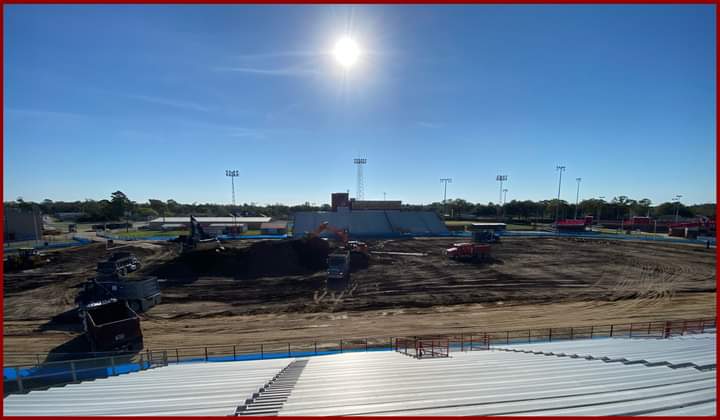 1 point
-
PN-G 8-4 vs Texas High 11-0, Friday 6:00, Natchitoches LA
Tyler Dixson reacted to Cougar14.2 for a post in a topic
1 pointThat’s crazy because they’re all on the roster except Crites who’s the only one who doesn’t have an offer. Some of them did have different numbers though. You don’t get offers if you don’t play, you don’t have to be an expert to know that. That’s recruiting 101, this is probably just a more informed board than the one you’re used to posting on.1 point -
Port Arthur Memorial 43 Little Cypress-Mauriceville 35/FINAL
no-look reacted to Mr. Buddy Garrity for a post in a topic
1 pointWe won a game!!!!! I'm going play the lotto right now.1 point -
Recently, 4500-6000 fans for away games. farther we go into the playoffs, the bigger the crowds get.1 point
-
2A, 1A Monday, Nov. 22/Post updates here
RETIREDFAN1 reacted to AggiesAreWe for a post in a topic
1 pointWest Hardin 67 Chester 281 point -
PN-G 8-4 vs Texas High 11-0, Friday 6:00, Natchitoches LA
prepballfan reacted to Stattrax for a post in a topic
1 pointI have to be honest. I would love to see PNG win. For a few reasons. I won’t put them out here, because it’s only my opinion. But I would like to see this group of kids prove a lot of people wrong.1 point -
2A, 1A Monday, Nov. 22/Post updates here
RETIREDFAN1 reacted to AggiesAreWe for a post in a topic
1 pointGoodrich 39 Colmesneil 621 point -
Kyle Rittenhouse Trial
Unwoke reacted to CardinalBacker for a post in a topic
1 pointBUT, if you go out breaking windows, setting fires, and assaulting people you should kinda expect to get your head blown off, too, right? It's a possibility at least. I mean, if those boys weren't out breaking multitudes of laws, they'd still be alive, too.1 point -
Whoever executes their offense the best wins this one. Turnovers will kill any team. In this game they are doubly bad. This is another potential score fest game if PNG Offense can protect the QB. Praying for no injuries on either team, and, of course, no rain!!!1 point
-
A leopard doesn’t change its spots….. Beto O'Rourke stands by infamous pledge to 'take' guns from Americans if elected Texas governor https://www.foxnews.com/politics/beto-orourke-stands-by-infamous-pledge-take-guns-from-americans-if-elected-governor Explore the Fox News apps that are right for you at http://www.foxnews.com/apps-products/index.html.1 point
-
1 pointJordan Smith, Vidor’s NG. Was District Defensive MVP as a Junior. Rarely see a kid get doubled or tripled every play, and still get in on tackles and sacks. Another stat that isn’t recorded is the number of bad snaps by the opposing Centers, obviously thinking more about how to block Jordan than snapping the football. And the holding calls by offensive linemen, lol. Many a yard. Even the 417 pound Center from Chapel Hill was nothing more than a minor obstacle. No doubt in my mind the opposing OC started off their game plans with, “How do we block the NG”. If someone ask me to describe him in one word, WOW.1 point
-
Best SETX kids
undiscovered reacted to Tiger33 for a post in a topic
1 pointLCM he is Junior defensive end. Amier Washington offers Baylor and Texas Tech. LCM Da'marion morris RB/CB junior LCM Ashton Landry QB Senior LCM Carson Peet Senior SS ETBU LCM Dwight Davis senior safety1 point -
1 pointWelp looks like they are tightening the belt in the Metroplex. Let’s just hope Coach really loves that mom… https://twitter.com/dmngregriddle/status/1446525923696730112?s=211 point
-
1 pointI respect a coach that will literally “take one for the team.” But just imagine if he could have landed Emoni Bates’ mom???1 point